We are delighted to feature a guest post from David Coxon, Honorary Vice President of Tangmere Military Aviation Museum.
David writes:
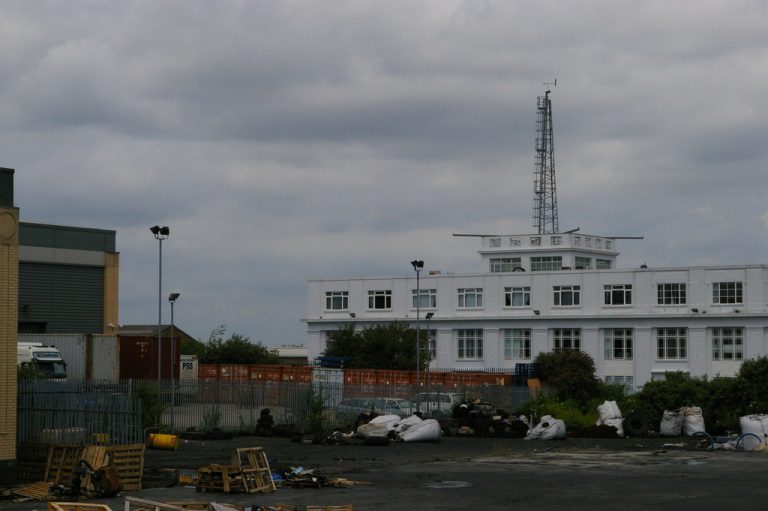
In the late 1920s a Watch Office was constructed at RAF Tangmere to accommodate the Duty Pilot and to which visiting pilots had to report. It was a detached building built adjacent to the most eastern General Purpose Shed (hangar) to drawing number 1597/27. The Watch Office consisted of a brick built structure with cavity walls and a close coupled roof. The entrance was roughly in the centre of the front elevation which led into a lobby area and the rooms consisted of the watch office with a bay window and a rest room. Heating was by a pair of fireplaces positioned back-to-back. Equipment in the Watch Office was very basic; a board to record known aircraft movements and an Aldis lamp and Very pistol to pass signals to aircraft. This Watch Office was destroyed during the bombing of the airfield on 16 August 1940, during the Battle of Britain.
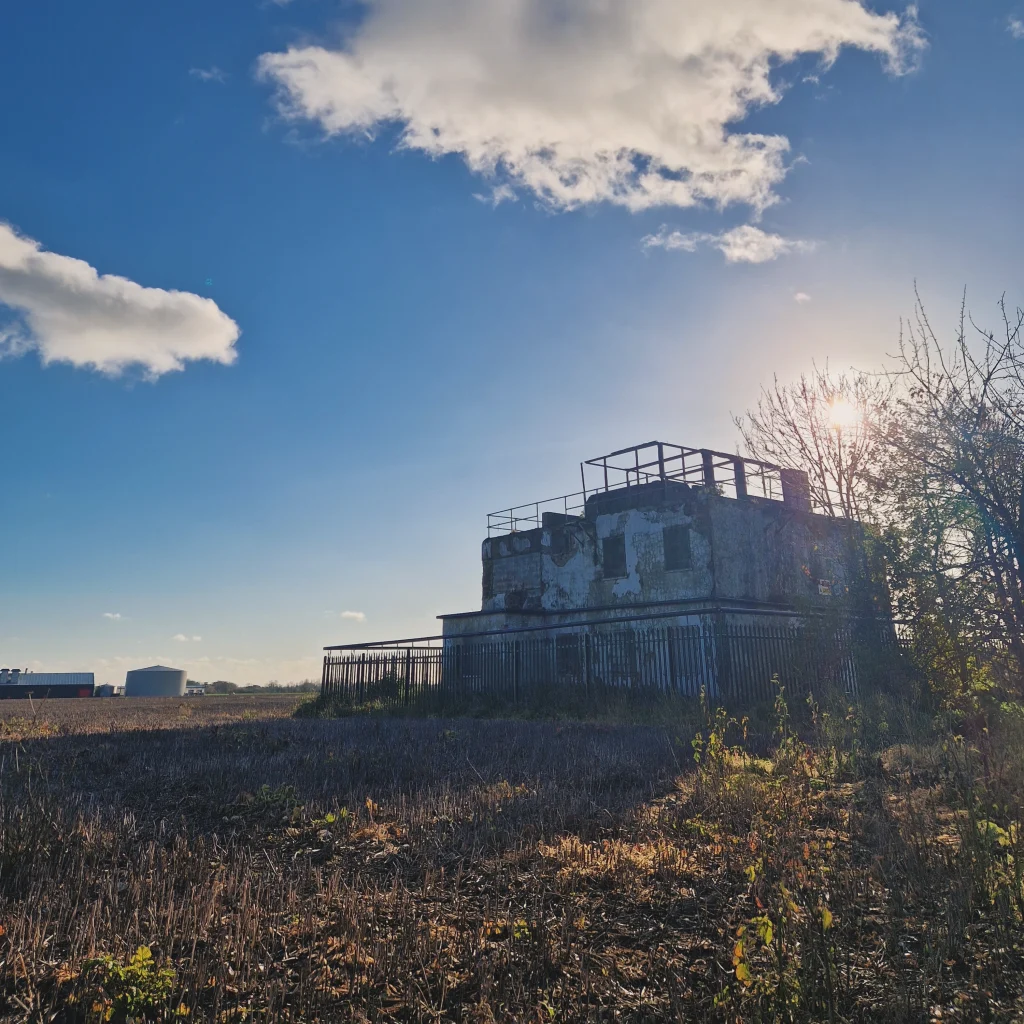
About 1942 a new Watch Office was constructed on the north side of the airfield adjacent to a taxiway and the threshold of Runway 16. It was built to drawing 12096/41 (Watch Office for Night Fighter Stations) of a brick construction with four walls 13.5 ins thick, supporting a reinforced concrete floor, balcony and roof. The roof and balcony were reinforced with concrete beams. The rear of the building was practically blind with only a small window on the ground floor opposite the staircase. Access to the roof was by a ladder bolted to the rear wall.
Inside the building, the main entrance, at the rear, led into a lobby area and corridor and immediately on the left was the concrete staircase connecting with the first floor. The electric mains and standby power entered the building to a switching area under the stairs. Opposite the staircase were toilets for both airmen and officers and opposite was a store room. The adjacent room on the right was a rest room and opposite this was the meteorological observers’ office. At the front of the ground floor was the watch office room complete with a pyrotechnic cupboard in one corner and between the watch office and the rest room on the right was a side entrance. The staircase led to an ‘L’ shaped landing and corridor, the controller’s rest room was on the right with an adjacent store room. Opposite, was a wireless operators’ room containing three cubicles. Curtain rails were installed on the ceiling to allow the entire room to be blacked out. Access to the balcony was by two steel doors.
During the war aircraft carrying out instrument approaches were assisted by Tangmere controllers using ground based Direction Finding (D/F) equipment to enable, for example, a ‘ZZ’ approach to be carried out. Towards the end of the war a timber and glass visual control room (VCR) was constructed on the roof to control aircraft on and adjacent to the aerodrome (local control). A staircase was constructed from the first floor to allow access to the VCR which included the lighting panels for the aerodrome and approach lighting systems. Post war, the term Watch Office was changed to the more appropriate name of Control Tower and Tangmere’ s first floor control room was modified as a radar room to accommodate two ACR 7 radar sets. This surveillance radar had a one degree beam width that enabled the controller to ‘talk-down’ aircraft carrying out a surveillance radar approach to half a mile from touch down and for aircraft in emergency to the runway threshold. Aircraft would be passed miles from touchdown with advisory heights and the controller would instruct the pilot to fly magnetic headings, left or right, to ensure the aircraft was lined up with the runway centreline on final approach.
Outside, in front of the Control Tower, a signals square and the letters ‘TG’ were laid out with a ‘Landing T’ (the direction for aircraft to land) and a symbol to indicate that take-offs and landings to be made only on the runways. Adjacent to the Control Tower, a large wooden building was built after the war to hold the aerodrome’s meteorological office. A runway control van was placed at the threshold of the runway-in-use to monitor aircraft on final approach and taking-off.
David Coxon, Former Curator and Director, Tangmere Military Aviation Museum, August 2025