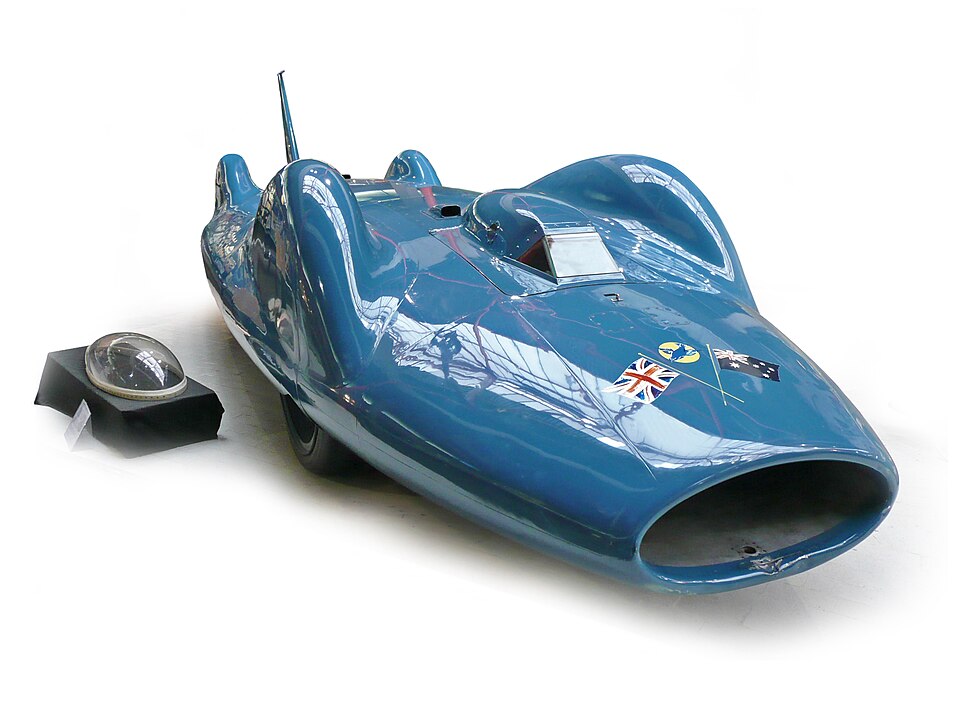
We are delighted to feature another guest post from David Coxon, Honorary Vice President of Tangmere Military Aviation Museum.
David writes:
In 1956, Donald Campbell began planning an attempt to break the land speed record which then stood at 349 mph set by John Cobb in the Railton Mobil Special. The Norris Brothers, based in Haywards Heath, Sussex, designed a vehicle called the Bluebird-Proteus CN7 with the aim of a achieving a land speed of 500 mph. The CN7 (Campbell-Norris 7) was constructed by Motor Panels of Coventry and was completed by the spring of 1960. It was the first land speed attempt vehicle to be powered by a gas turbine engine; the Bristol Siddeley Proteus. Designed and manufactured by the Bristol Aeroplane Company, the jet turbine engine (Proteus 705) delivered 4,500 shp of thrust but had to be specially modified by Norris Brothers with a power shaft at the end of the engine that connected directly to final drive assemblies and half shafts to provide power to all four wheels.
Following low speed tests conducted at the Goodwood motor racing circuit, the CN7 was taken to Bonneville Salt Flats in Utah, USA, the location of his father’s land speed record success in 1935. In early September 1960, CN7 accelerated from a standing start to 400 mph in 24 seconds, using about 80% of the engine’s full power. However, the attempt failed when the CN7 was severely damaged during a high speed crash on 16 September. Campbell suffered a fracture to his lower skull, a broken ear drum and cuts and bruises. He convalesced in California until November 1960 where he decided to continue and make a further attempt.
The rebuilt car was completed with modifications including differential locks and a large vertical stabilising fin. In the summer of 1962, after initial trials on the Goodwood motor racing circuit, further tests were conducted on the main runway at RAF Tangmere, courtesy of the station’s commanding officer, Group Captain Peter Hughes. No permission to enter the runway from ATC in the control tower was required, Hughes had made the whole airfield available for testing.
Following the tests CN7 was shipped to Australia for a new attempt at Lake Eyre, (435 miles north of Adelaide) in 1963. The Lake Eyre location was chosen as it offered 450 square miles of dried salt lake, where rain had not fallen in the previous 20 years and the surface was as hard as concrete. However rain did fall and by late May the rain became torrential and the lake flooded. The 1963 attempt was over.
Campbell and his team returned to Lake Eyre in 1964 but the salt surface never returned to the promise it had held in 1962 and Campbell had to battle to reach a speed of over 400 mph. On 17 July he finally did so, achieving a new record land speed record of 403.17 mph for a four-wheeled vehicle (Class A). If the salt surface had been hard and dry there can be no doubt that CN7 would have set a record in excess of 450 mph and perhaps close to her design speed of 500 mph.
CN7 is now on permanent display at the National Motor Museum, Beaulieu, Hampshire.
The current holder of the Outright World Land Speed Record is ‘ThrustSSC’ driven by Andy Green, a twin turbofan jet-powered car which achieved 763.035 mph – 1227.985 km/h – over one mile in October 1997. This is the first supersonic record as it exceeded the sound barrier at Mach 1.016 – Editor