We are delighted to feature another guest post from David Coxon, Honorary Vice President of Tangmere Military Aviation Museum.
David writes:
RAF High Speed Flight attempt
In early 1946, the Air Ministry, the Ministry of Supply and Commander-in-Chief Fighter Command all agreed that the record set the previous year by Group Captain “Willy” Wilson in Britain’s new jet fighter, the Gloster Meteor, could be improved upon. In July 1946, the RAF High Speed Flight was reformed and based at RAF Tangmere to make a new attempt.
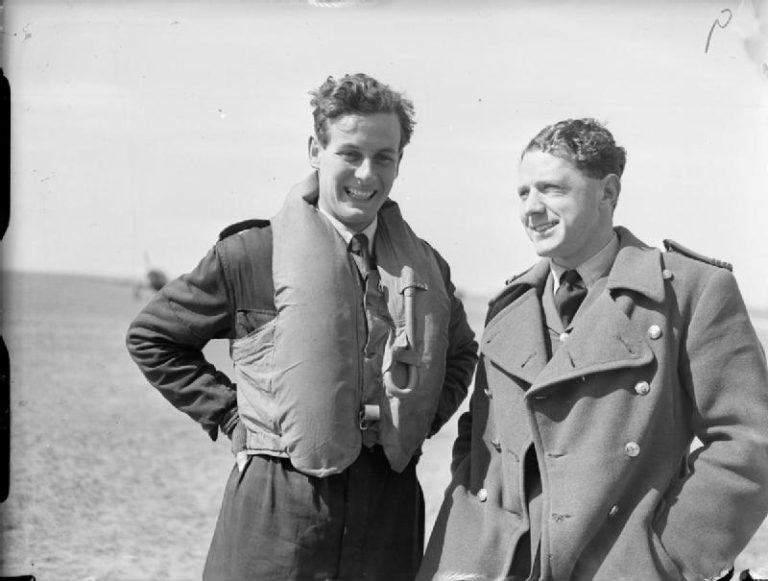
The flight was led by Group Captain E M (“Teddy”) Donaldson who announced his intention, “To raise the record to 621 mph at least”. Two other pilots were posted to the flight; Squadron Leader W A Waterton from the Central Fighter Establishment and Flight Lieutenant Neville Duke who was half way through his test pilot’s course at the Empire Test Pilots’ School, Cranfield. Based at Tangmere, it was decided that the attempt should be made over a 3 km course off the Sussex coast at Rustington, near Littlehampton. The procedures were laid down by the Fédération Aéronautique Internationale (FAI) and to ensure the strict rules were complied with, Tangmere’s No 29 Squadron provided Mosquito aircraft with observers to monitor the aircraft’s flight on the measured 3 km course. Timing cameras were placed at either end of the course and on either side; balloons were flown to provide guidance to the pilot of his altitude.
The flight was provided with standard line-production Gloster Meteor Mk 4s with cleaned up fuselages and uprated Derwent engines delivering 4,300 lb of thrust (about 30% above normal).
By the middle of August, the High Speed Flight was worked up and ready for the record attempt but warm weather was required to achieve the best speed. On 13 and 19 August full timed practice runs were carried out but then unfortunately poor weather conditions set in. So unpromising was the weather forecast at the end of August that Neville Duke was dispatched to Prague to demonstrate the Meteor to the Czechs. The Czechs wined and dined him and bestowed upon him their Military Cross.
Eventually on Saturday 7 September 1946 a break in the poor weather finally arrived and at 1745 hours Donaldson took off from Tangmere in Meteor EE 549 to attempt the record. He landed back fourteen minutes later having returned an average speed of 615.78 mph over the course – he was the new World Airspeed Record holder.
Hawker Aircraft Ltd attempt
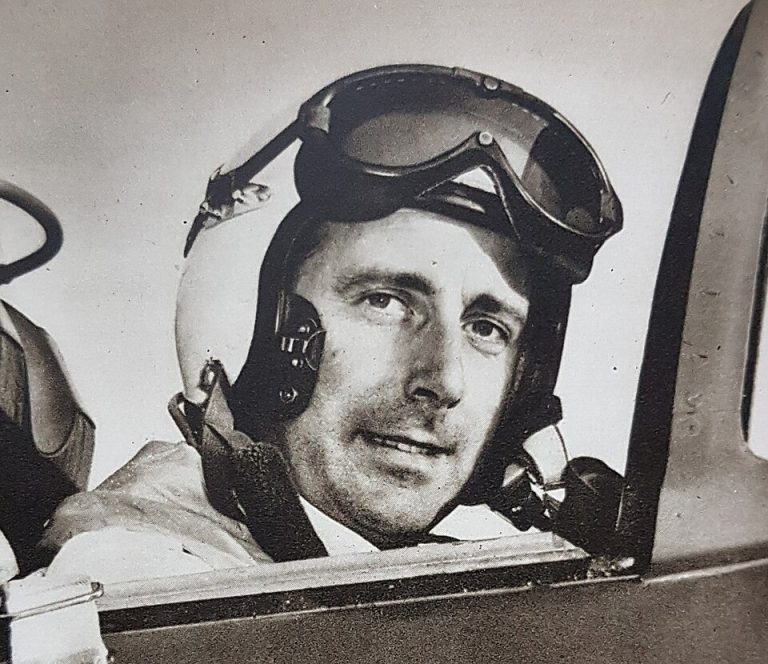
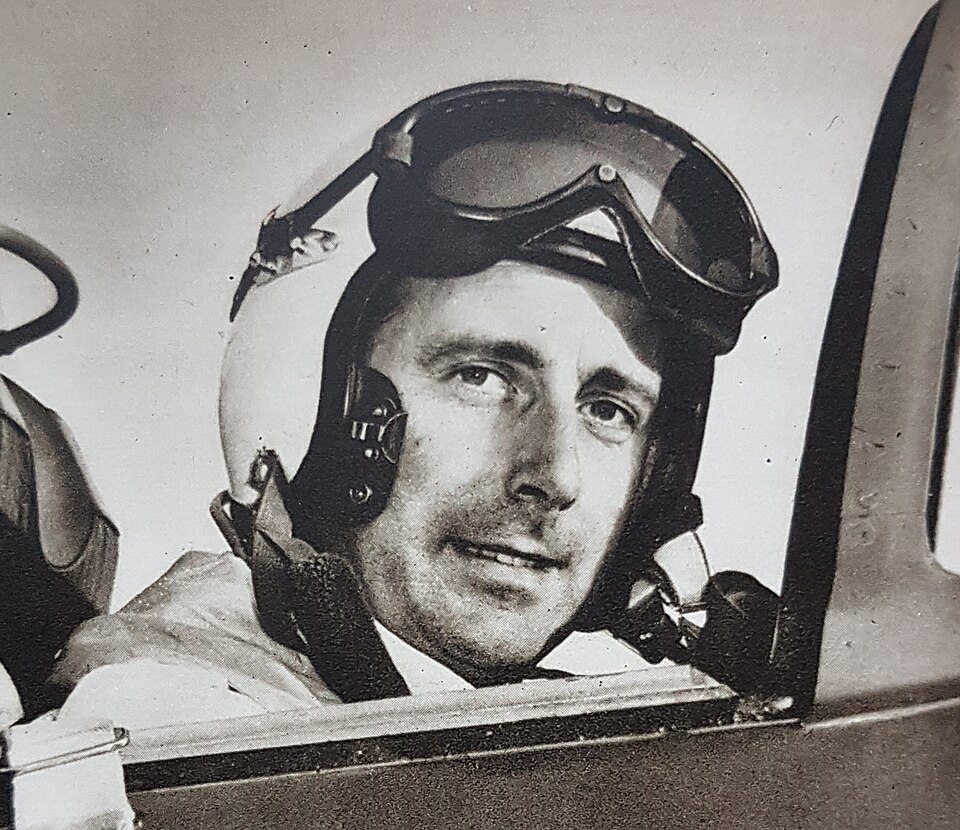
In the early summer of 1953 the Hawker Aircraft Ltd believed that their new Hunter aircraft could regain the World Air Speed Record (held by a North American F-86D Sabre) for Britain and decided to modify their prototype aircraft WB 188 for the attempt. Neville Duke, by then Hawker’s Chief Test Pilot would be the pilot. WB 188 was fitted with a streamlined “needle” nose and a rounded front windscreen to the cockpit and was painted red to assist the photographic time keepers from the National Physical Laboratory. As it was Coronation year it was felt that in spite of the climatic disadvantages the record attempt should be made in Britain. The choice was the established course already surveyed for the 1946 High Speed Flight attempt. The base chosen was again RAF Tangmere (Commanding Officer, Group Captain “Johnny” Kent) with support aircraft being again provided by Tangmere’s No 29 Squadron. In 1946 it had been Mosquitoes; in 1953 it was to be Meteor NF 11s. Unlike the full RAF support in 1946 of multiple course markers, air-sea-rescue Walrus and marine rescue craft with balloons flown at 300 feet to assist the pilot, the 1953 attempt only had marker buoys to indicate the beginning and end of the 3 km measured course. Assistance for the pilot was not a problem; Neville Duke as he had said afterwards, “….. flown the course a couple of hundred times already”.
All was ready by the end of August 1953 and on 30 August Neville Duke took off from Tangmere for the first record attempt. Unfortunately, on the last of four practice runs the Avon engine began to run intermittently after reheat had been opened up and the attempt was abandoned. For the next attempt, on 1 September, it was decided to take off at dawn when calmer weather conditions were likely to be present. Unfortunately Tangmere was fogbound and the fog did not clear sufficiently for takeoff until about 0700 hours. Neville Duke later described that flight as follows:
“I turned off from Tangmere on to course, dropping the nose to build up speed rapidly. Coming down first from a thousand feet I lined up on the marker flares seven miles away. Under the rules governing the record I had to be down to below 328 feet by a point a kilometer ahead of the start of the course.
I caught a glimpse of Bognor Pier and my indicated airspeed was registering 550 knots. I switched in reheat. There was a surge of acceleration, followed by a loud bang. The Hunter flipped over in a vicious roll to starboard, and a force of six and a half ‘g’ crushed down on my ribs and nearly blacked me out. Beach and sea had swum into the place of the sky and were coming closer every second. I cut off the reheat, thrust over the stick, and came out of the roll, right way up, at about 200 feet.
I looked out at the wing and saw part of the undercarriage leg sticking through a jagged hole in the wing surface. The aerodynamic stresses and strains of the high speed had sucked out the undercarriage leg and smashed it through the wing like a cannon shell.
I took some deep breaths. I felt sick from bitter disappointment at this violent interruption when I was keyed up, going flat out for a record that I knew I must have easily achieved in such favorable conditions.
I flew back to Dunsfold (Hawker’s airfield) and circled around burning up fuel so that the landing on one leg would be as light as possible. Below on the aerodrome I could see the red fire engines at readiness. At last with the tanks reading ‘zero’, I put the Hunter on final approach, keeping up the wing by the aileron, holding off as long as possible, and gently brushing the one wheel on to the runway. As the speed fell, the aileron control lost its effectiveness. The wing dropped and the Hunter swung round in a circle on the port wingtip and the starboard wheel.
All things considered, I had survived the disaster very well. If the undercarriage leg had come out seconds later we should both, the Hunter and me, have flipped straight into the sea. We managed to land, too, with the minimum of damage that could be expected in the circumstances. A lot of hard work followed and I marvelled at the way the ground crew had the repairs done and the Hunter re-cellulosed, looking like new and ready for another attempt within a week.”
After the attempt of 1 September the actual record breaking run was somewhat an anticlimax. On 7 September Neville Duke was back at Tangmere after fifteen minutes having achieved a mean average over the four runs of 727.63 mph. He was proclaimed in next day’s papers as “The Fastest Man on Earth!”
The two record holders, Meteor EE459 and Hunter WB188, have been displayed in the Tangmere Military Aviation Museum since 1992. ‘Teddy’ Donaldson died in June 1992 and is buried in St Andrew’s churchyard, Tangmere. Neville Duke (Hon. President of the Museum from 1982) died in April 2007 and his ashes are interred in the same churchyard.