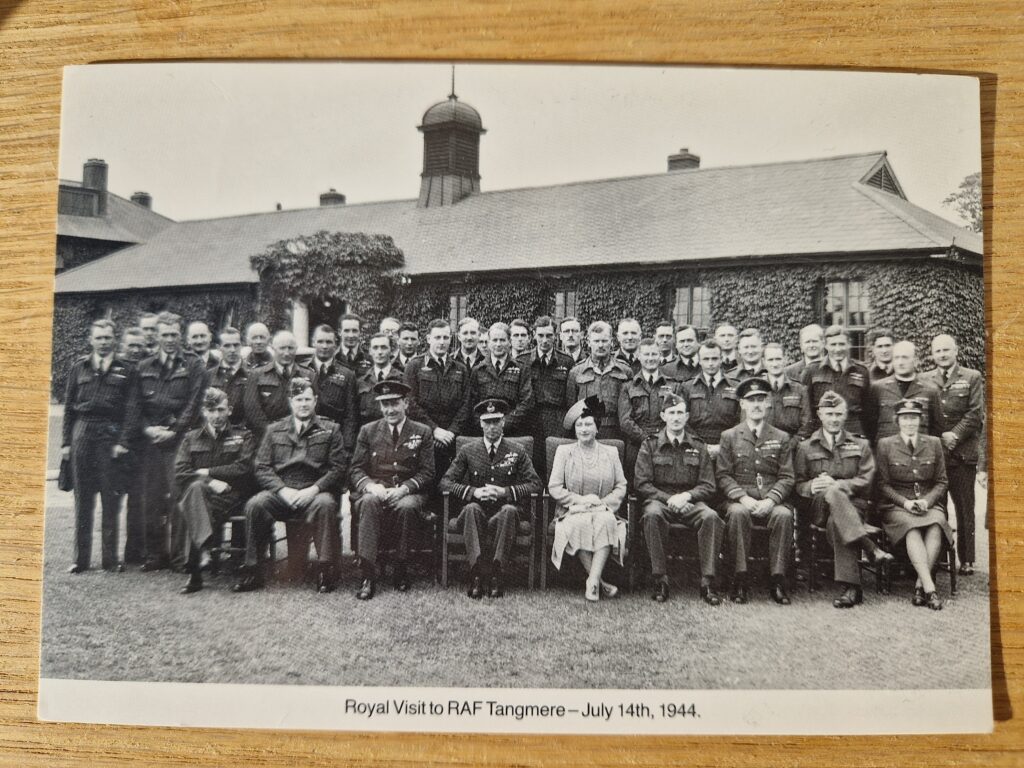
We are delighted to be able to feature a series of guest posts from David Coxon, Honorary Vice President of Tangmere Military Aviation Museum. Over the next few months, we will publish a weekly article from David, revealing stories encountered during his engagement with the history of RAF Tangmere and its Control Tower. We are extremely grateful for David’s ongoing support and hope that you enjoy this series of updates.
David Coxon worked for nearly forty years as a civilian Air Traffic Controller at the London Air Traffic Control Centre and Gatwick, as Manager ATC at Birmingham and as a Principal Inspector ATC for the CAA. After retiring in 2004 he joined the Tangmere Military Aviation Museum as a volunteer where he was appointed Curator in 2007. He retired from the Museum in 2023 having served the last six years as Deputy Director and Director. On retirement was made an Honorary Vice President of the Museum.
David writes:
In 1953, Queen Elizabeth II’s Coronation Year, Group Captain John Alexander ‘Johnny’ Kent was appointed Commanding Officer of RAF Tangmere. At this time, in addition to being a fighter station, RAF Tangmere was a Master Diversion Airfield with its own Customs Officer. This meant that the airfield received about 2,000 visitors a year, including His Royal Highness the Duke of Edinburgh who would regularly fly in, using his R/T callsign, ‘Rainbow’, when visiting nearby Goodwood and Cowdrey Park (to play polo) and Arundel Castle when the Queen was visiting the Duke and Duchess of Norfolk.
In 1954, Group Captain Kent hosted the Queen when she was at Tangmere to see Prince Philip depart in a Royal Canadian Air Force DC4-M North Star aircraft for the opening of the Vancouver British Empire and Commonwealth Games. In 1956, Kent’s last year at Tangmere, Prince Philip was often present on the airfield gaining experience on flying helicopters.
In 1968 His Royal Highness Prince Charles (now His Majesty King Charles III) began his flying training at RAF Tangmere with RAF flying instructor Squadron Leader Philip Pinney in a de Havilland Canada Chipmunk T10 (WP903). He flew WP903 on 30 July, and 1, 2 and 3 August and it was at RAF Tangmere where Prince Charles, later in his training, passed his Private Pilots’ Licence and earned his RAF preliminary flying badge.
After his first few Chipmunk flights at Tangmere, Prince Charles, with Philip Pinney as his flying instructor, continued his Chipmunk and Beagle Basset flying training whilst he was at university. Most of his training was flown from RAF Oakington near Cambridge. Prince Charles went solo in WP903 on 14 January 1969, not from Oakington where the crosswind on that day was too strong for solo flights, but from nearby RAF Bassingbourne. After leaving Cambridge University he flew from RAF Aberporth during his term at Aberystwyth University and from RAF Benson, Oxfordshire and other RAF airfields during his university vacations.
WP903 made its last RAF sortie when it was flown, with Pinney at the controls, from Benson on 10 October 1969 to the storage facility at RAF Shawbury, Shropshire. The aircraft remains airworthy and is now civil registered (G-BCGC) based at Old Warden and owned and operated by the Henlow Chipmunk Group. On 14 August 2022 Group Captain Philip Pinney was reunited with WP903 at Goodwood airfield at a meeting of RAF training aircraft.