We are delighted to feature another guest post from David Coxon, Honorary Vice President of Tangmere Military Aviation Museum.
David writes:
Design work on the vertical/short take-off and landing P1127 aircraft began in 1957 by Sir Sydney Camm and Ralph Hooper of Hawker Aircraft and Stanley Hooker and Gordon Lewis of the Bristol Engine Company. Instead of using rotors or a direct jet thrust, the P1127 used an innovative vectored thrust turbofan engine, the Pegasus.
The Pegasus 1 engine was rated at 9,000lb of thrust and first ran in September 1959. A contract for two development prototype aircraft was signed in June 1960 and the first tethered flight of the P1127 followed on 21 October 1960 at Dunsfold aerodrome. On 19 November the first untethered hover was achieved and in February of the following year the first conventional flight was achieved, flown by Bill Bedford and lasting 22 minutes. Four months later another milestone was reached when the P1127 performed the first transition from vertical hover to horizontal flight. On 2 November 1960 the Ministry of Supply issued a contract for a further four P1127 prototypes to develop the aircraft further towards being a realistic combat design. Improved models of the Pegasus engine were rapidly developed such as the Pegasus 3, capable of producing 15,000lb thrust.
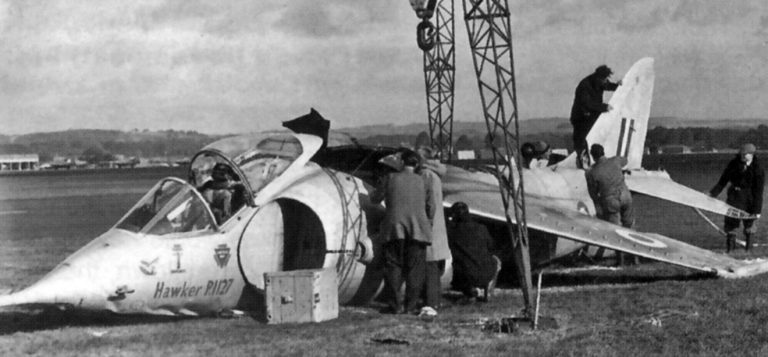
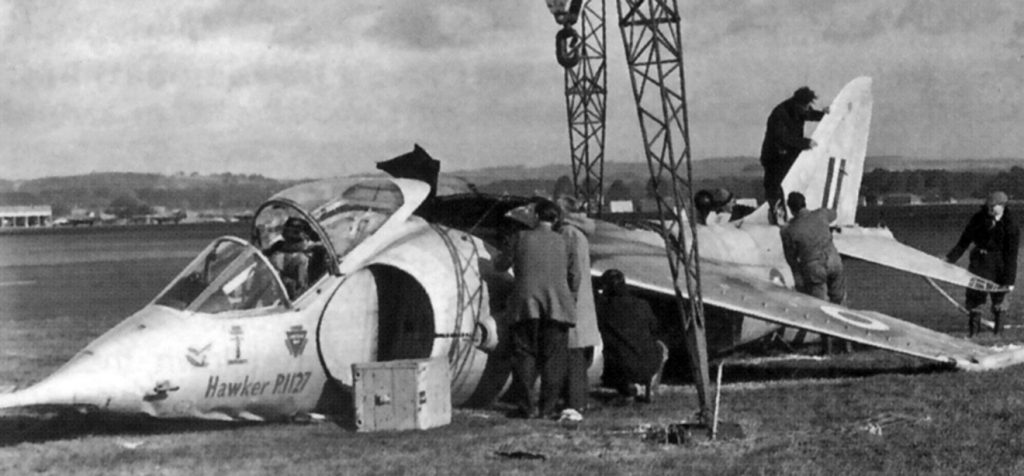
Of the six P1127s built, three subsequently crashed. All the pilots involved survived. The first prototype (XP831) publicly crashed at the 1963 Paris Air Show due to a speck of dirt in the air feed nozzle control motor, causing the engine nozzles to stick. On 30 October 1962 one of the second batch of prototypes, XP972, flown by test pilot Hugh Merewether, suffered an engine failure. The engine caught fire following a surge and Merewether had to make an emergency landing at RAF Tangmere with the undercarriage partly extended. Merewether elected to land on the grass to the south of runway 25 and the RAF aerodrome fire service (AFS) alerted by the control tower, responded promptly to the aircraft accident, which fortunately did not result in the aircraft catching fire. Hugh Merewether escaped unhurt from the cockpit but the severely damaged aircraft, was a write-off.
A year earlier, in 1961, the UK, USA and West Germany jointly agreed to purchase nine aircraft developed from the P 1127 for the evaluation of the performance of vertical short take-off and landing aircraft (V/STOL). The aircraft was called the Kestrel and its first flight was flown by Bill Bedford, Hawker Chief Test Pilot on 7 March 1964.