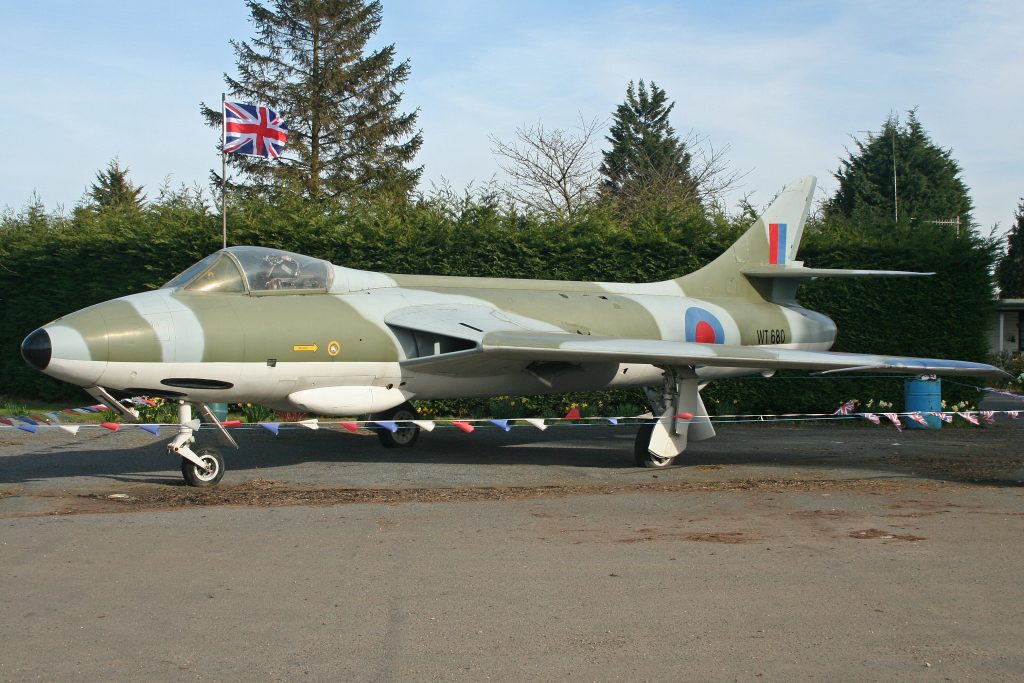
We are delighted to feature another guest post from David Coxon, Honorary Vice President of Tangmere Military Aviation Museum.
David writes:
In early 1955 there was no official Fighter Command aerobatic team. No 54 Squadron, recently re-equipped with the Hawker Hunter 1, saw an opportunity to form a team using the latest type of jet fighter in service. Practice started at its base, RAF Odiham, Hampshire in April and a month later, the four man team which included Pilot Officer Bernard Noble, was accepted as the official 1955 Fighter Command formation aerobatic team. During the following months the team carried out 21 official displays including performing in Geneva, Switzerland, Metz in France and at the Farnborough Air Show in September.
At the end of the display season, on 3 November, Captain Dick Immig, the team’s leader, arranged for a USAF photographer and an ITV photographer to visit Odiham to take aerial shots of the team. The weather on this day over southern England was poor with a cloud base of 300 feet in drizzle. As the top of the cloud was about 5,000 feet, Dick decided to go ahead with the sortie and six aircraft took off from Odiham. In addition to the team’s four Hunters a Vampire T11 and a Meteor NF14 night fighter also departed; the Vampire with the USAF photographer and the Meteor with the television photographer on board.
After joining up above cloud the photographic session commenced. Photos were taken of the team performing aerobatics. However, in doing so the aircraft drifted away from their base, resulting in all six aircraft arriving back in the Odiham area short of fuel. Odiham ATC homed the aircraft to overhead for a controlled descent to the west of the airfield, to be picked-up on radar for a ground controlled radar ,approach (GCA) to Runway 10. Unfortunately the Vampire and the first pair of Hunters, including one flown by Noble, were not lined up sufficiently to be picked up by Odiham GCA and in accordance with the standard missed approach procedure the aircraft were transferred to Farnborough Radar for a radar approach to an easterly runway at Farnborough.
Unfortunately, the Farnborough Radar controller was unable to identify the overshooting Vampire and the pilot, with little or no fuel remaining, was forced to climb above the cloud where he jetissoned the cockpit canopy, rolled the aircraft inverted, thereby enabling both occupants to escape the cockpit and open their parachutes. The pilot and the American photographer, who had never flown before, landed without injury. Farnborough also failed to identify the two following Hunters and one of the pilots decided to eject. This he did successfully and landed by parachute without incident. Bernard Noble, climbed to clear air and expecting also to have to eject, made a Mayday transmission. Both Biggin ATC and Tangmere ATC responded immediately but as Noble’s distance measuring equipment (DME) indicated a range of only fifteen miles from Tangmere he called Tangmere for assistance. Squadron Leader John Jarvis, the unit’s Senior Air Traffic Control Officer, replied with a course to steer to the airfield. Noble’s Hunter was north-east of Tangmere and he levelled the aircraft out at 7,000 feet. After John Jarvis reported that the cloud base at the airfield was 800 feet, Noble decided to make an approach for a forced landing with the option of ejecting if necessary. With both fuel gauges showing zero, he closed the throttle, pushed the nose down to increase speed to either land at Tangmere or to pull up and eject. Jarvis passed Noble headings to steer each time he transmitted and just north-west of the airfield he broke cloud in a left turn over Chichester, immediately recognising where he was. Still turning hard left, with the aircraft at high-speed, Noble realised he would be unable to land on the main runway. Undercarriage and full flap hastily lowered, he then lined up to touch down on the grass parallel to the runway. The touchdown was firm but the braking action on the grass was poor and as the aircraft was heading towards concrete blast pens on the far side the airfield, Noble selected undercarriage ‘up’. The aircraft porpoised along its belly, eventually turning around and stopping short of the pens. The first person to reach the aircraft was the Station Commander, Group Captain ‘Johnnie’ Kent who had been driving his car around the perimeter track. After Noble had given him a brief explanation of the reason for this unseemly arrival on his airfield, Kent looked at his watch and said, “It’s 11 o’clock, let’s go and open the bar!” A brief visit was paid to the control tower for Noble to thank John Jarvis for getting him out of trouble and after a couple of drinks and lunch he was loaned a car to take him back to Odiham.
But what happened to the other aircraft? Odiham GCA radar was again unable to line up with the Odiham runway the two following Hunters but Farnborough Radar was able to identify them after they carried out a missed approach and they were then successfully vectored to a landing on Farnborough’s 05 runway with little fuel remaining. The Meteor, flying on one engine to conserve fuel, eventually safely broke through the low cloud and was able to land at Odiham, the only aircraft to land back at base.
This article is based on material provided in 2010 by Vanessa Herold, the daughter of Bernard Noble